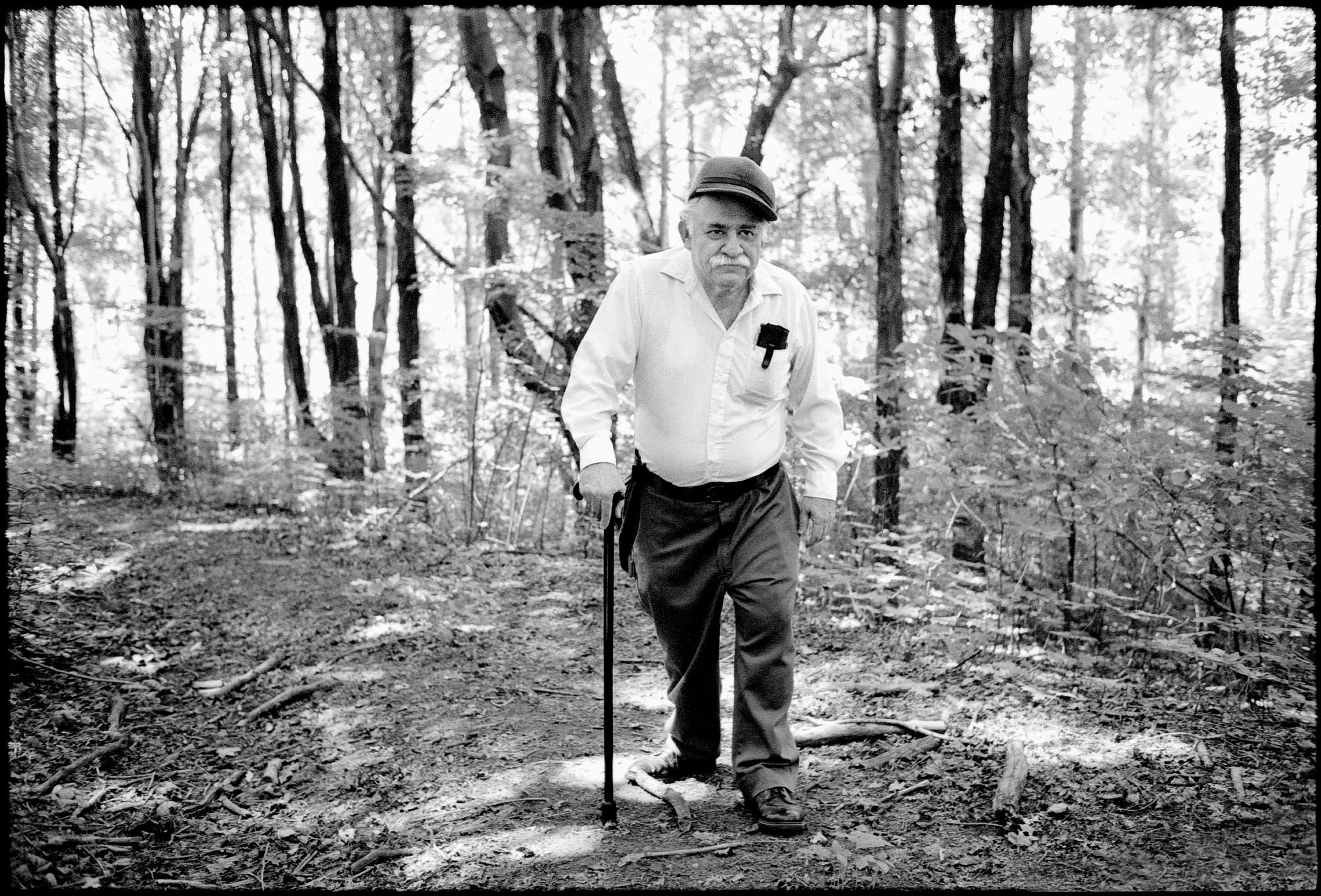
Trade-union militant, foundryman, autodidact, philosopher of the city: Beginning in the 1950s — long before public awareness of chemical pollution, urban blight, or a warming planet — Bookchin insisted that the ecological question is a social question, and that freedom is its only durable answer. What follows is the arc of that life, era by era.
“What compels me to fight is outrage over injustice, a love of freedom, and a feeling of responsibility for enlarging the human spirit.”
Born January 14, 1921 to Nathan Bookchin and Rose Kaluskaya, Russian-Jewish immigrants steeped in revolutionary politics. The street corners, union halls, and tenements of the Bronx were his first school.
1921 — Born in the Bronx, New York City, and raised partly by his grandmother Zeitel, a former Socialist Revolutionary.
1930 — Joins the Young Pioneers, the communist children’s organization, at age nine; later the Young Communist League.
1930s — The Depression bites — evictions, odd jobs from age twelve: selling ice cream in the park, hawking the Daily Worker on street corners.
1939 — Expelled from the communist movement after the Hitler–Stalin pact, accused of “Trotskyist-anarchist deviations.”
A decade on shop floors — a foundry in New Jersey, then auto plants — organizing for the UAW and slowly losing faith in the industrial proletariat as history’s chosen agent.
1940s — Works as a foundryman and later an autoworker; serves in the U.S. Army; shop-floor organizer with the United Auto Workers.
1946 — Takes part in the great General Motors strike — for him, its settlement marked the end of the workers’ movement’s revolutionary horizon.
late ’40s — Drifts from Trotskyism toward the libertarian left, reading his way out of orthodoxy.
Writing under pseudonyms for the journal Contemporary Issues, Bookchin turned to questions no left tendency was asking — food, chemicals, cities, the texture of everyday life.
1951 — Marries Beatrice (Bea) Appelstein, whom he met speaking at City College — a partnership, and later a lifelong friendship and alliance.
1952 — “The Problem of Chemicals in Food” appears under the name Lewis Herber — an early alarm about industrial agriculture.
1950s — Writes as Lewis Herber, M. S. Shiloh, Robert Keller, and Harry Ludd; abandons Marxism for libertarian socialism.
1958 — Begins the research that will become Our Synthetic Environment — ecology as a political question.
Months before Silent Spring, Bookchin published a book-length case that modern society was poisoning its own ground. Then he did what no one else had: he fused ecology with the idea of freedom.
1962 — Our Synthetic Environment published (as Lewis Herber) by Knopf, six months before Rachel Carson’s Silent Spring.
1963 — In lower Manhattan, active in the civil-rights congress CORE and the early movement against the war in Vietnam.
1964 — “Ecology and Revolutionary Thought” introduces social ecology — ecological crisis rooted in social hierarchy.
1965 — “Towards a Liberatory Technology” imagines renewable energy and automation serving decentralized, human-scaled communities.
1967 — Co-founds the Anarchos group and journal on New York’s Lower East Side.
late ’60s — The Bleecker Street apartment becomes a movement hub — Abbie Hoffman, Herbert Marcuse, and Raoul Vaneigem pass through as Anarchos comes together.
1969 — “Listen, Marxist!” circulates through a fracturing SDS — a broadside against the old workerist orthodoxy.
With Post-Scarcity Anarchism in print, Bookchin left New York for Burlington, Vermont — and set about building places where social ecology could be taught, argued, and lived.
1971 — Post-Scarcity Anarchism published; moves to Burlington, Vermont, his home for the rest of his life.
early ’70s — With Bea and the Anarchos circle, opens a Burlington coffee house — cheap meals, study groups, movement meetings.
1974 — Co-founds the Institute for Social Ecology with Dan Chodorkoff at Goddard College; joins the faculty at Ramapo College.
1977 — The Spanish Anarchists recovers the buried history of the world’s largest anarchist movement.
1977–79 — Active in the Clamshell Alliance’s mass direct action against the Seabrook nuclear plant.
His central book traced hierarchy from its first emergence — in age, gender, priesthood, and state — and argued that freedom, too, has a legacy: organic societies, communes, and assemblies waiting to be renewed.
1982 — The Ecology of Freedom: The Emergence and Dissolution of Hierarchy is published.
mid ’80s — Bea returns from Frankfurt with news of die Grünen and helps found the Burlington Greens.
1987 — Bea Bookchin runs for city council — the first consciously municipalist campaign in the country.
1987 — The Rise of Urbanization and the Decline of Citizenship; at the first U.S. Green gathering in Amherst, he publicly challenges deep ecology’s misanthropic turn.
1989 — Remaking Society — the most compact statement of the whole project.
The final decade of the century was combative: defending reason and social politics against mysticism and withdrawal, and giving his municipalism a name of its own.
1990 — The Philosophy of Social Ecology sets out dialectical naturalism, his philosophy of nature.
1991 — Defending the Earth — the public dialogue with Earth First!’s Dave Foreman.
1995 — Social Anarchism or Lifestyle Anarchism and Re-enchanting Humanity take aim at individualism and anti-humanism on the left.
1996 — The Third Revolution begins — a four-volume history of popular movements within the great revolutions.
1999 — Formally breaks with anarchism, naming his politics Communalism.
In his last years Bookchin condensed a lifetime into the essays later collected as The Next Revolution. He did not live to see how far they would travel.
2002 — “The Communalist Project” — the late summation: popular assemblies, confederation, a new politics of the city.
2004 — From an İmralı prison cell, Abdullah Öcalan reads Bookchin; democratic confederalism begins reshaping the Kurdish movement.
2006 — Passes away at home in Burlington on July 30, aged 85.
2015 — The Next Revolution published by Verso, edited by Debbie Bookchin and Blair Taylor; his ideas are cited from Rojava to municipalist city halls.
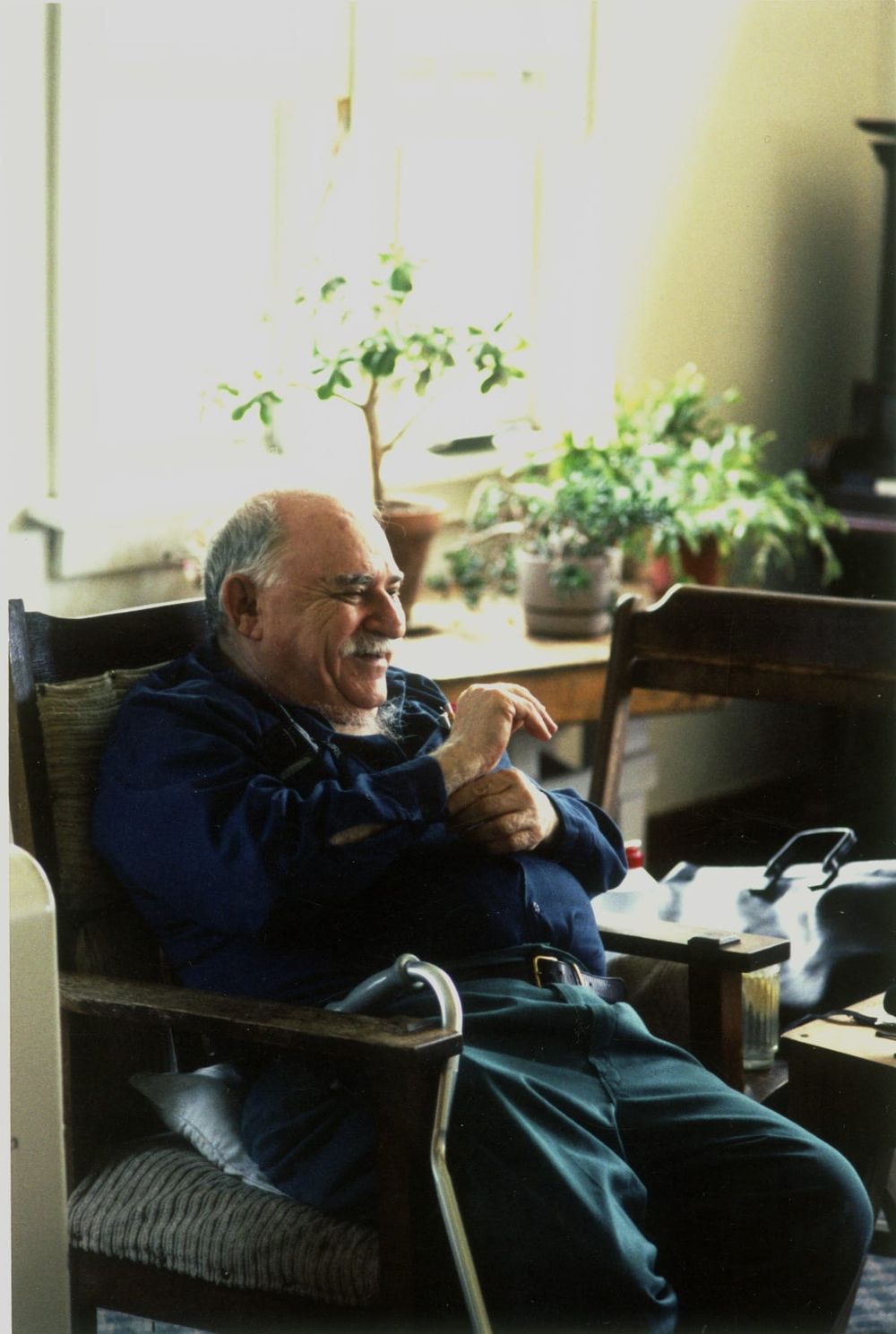
Murray passed away at home in Burlington on July 30, 2006. The ideas did not stop moving.
See where they wentThe Murray Bookchin Legacy Foundation is a registered 501(c)(3) nonprofit dedicated to preserving and expanding Murray’s intellectual legacy. For years after his passing, that work — new translations and editions, library collections, cataloging, the editing of posthumous writing — was carried on ad hoc, by volunteers. The Foundation was established to sustain it.
Working with the Murray Bookchin Trust, it preserves and disseminates the archive, creates educational, research, and leadership opportunities for those who build on his ideas, sponsors conferences, lectures, and public forums, and works to place his writing online and in libraries around the world.
Each small heading below names one fixed line on the About page. Edit the text under a heading — never the heading itself. Delete a heading and its text to restore the built-in wording.
About
A Life Against Hierarchy
“What compels me to fight is outrage over injustice, a love of freedom, and a feeling of responsibility for enlarging the human spirit.”
— Murray Bookchin
Scroll the eras ↓
Murray passed away at home in Burlington on July 30, 2006. The ideas did not stop moving.
See where they went
Est. 2006
About the Foundation
The Murray Bookchin Legacy Foundation is a registered 501(c)(3) nonprofit dedicated to preserving and expanding Murray’s intellectual legacy. For years after his passing, that work — new translations and editions, library collections, cataloging, the editing of posthumous writing — was carried on ad hoc, by volunteers. The Foundation was established to sustain it.
Working with the Murray Bookchin Trust, it preserves and disseminates the archive, creates educational, research, and leadership opportunities for those who build on his ideas, sponsors conferences, lectures, and public forums, and works to place his writing online and in libraries around the world.
Support the work